
The Bob Richardson Rule

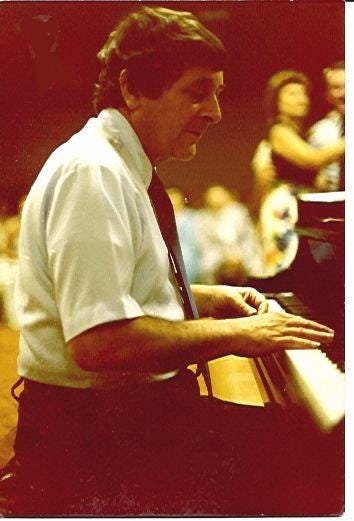
Allow me to tell you about one of my music professors at Auburn, the legendary jazz pianist Bob Richardson. Once, while playing through the Jerome Kern classic “All the Things You Are,” I hit a wrong note. It was a pretty bad mistake, and sounded to me like a real clunker, so I stopped playing and apologized to Bob. For as long as I live, I will never forget his reply. He said, “What mistake? You changed that Minor 7th chord to a Minor 7th with a flat 5, so I didn’t hear a mistake.” A little later, Bob continued by saying, “Whenever you play a note you think is wrong, play it two more times on purpose and everybody will think you meant it.”
That’s my whole essay in one piece of advice. Bob’s trick sounds like a sleight of hand — turn an error into a triumph just by committing to it twice more — and on its face it shouldn’t work. Logic says repeating a mistake ought to compound it and make it worse, not redeem it. If the first note was wrong, playing it again on purpose should just be wrong a second and third time, louder and with worse intentions. And yet every musician who has ever tried Bob’s advice knows that it magically works, almost without fail. That contradiction isn’t really a trick about music. It’s a clue about where instinct comes from, and about the unsettling possibility that some part of a trained mind knows what it’s doing before the rest of us catch up.
Start with what actually happened in my hand that day. I didn’t reach for a wrong note out of nowhere. I reached for a minor 7th flat 5 — what jazz players call a half-diminished chord — sitting right next to the minor 7th I was supposed to play, close enough in the harmony that a trained ear could mistake one for a cousin of the other. That’s not a random error. That’s a substitution, and a common one, the kind working jazz musicians reach for on purpose all the time. My fingers weren’t malfunctioning. They were pulling from the same well every correct note comes from, and this time the well handed back something adjacent instead of the exact match.
There’s actually a name for that “well,” or at least a name for the phenomenon of drawing from it without being able to explain how. The philosopher Michael Polanyi called it tacit knowledge, and he built an entire argument on a single blunt observation: we know more than we can explain. Think of a face you know as well as your own hand — a parent, a spouse, an old friend — and try to describe it precisely enough that a stranger could pick it out of a hundred others. You can’t, not really, and yet you’d recognize that face instantly in a crowded room. The knowledge is real. It’s just not sitting anywhere you can get at it with words. Polanyi’s other line cuts even closer to a bandstand: the skill of a driver, he said, cannot be replaced by a thorough schooling in the theory of the motorcar. You don’t need to be able to explain a chord substitution to reach for one correctly. The hand already knows the theory. It just doesn’t need to know the vocabulary for it.
Cognitive scientists have actually gone looking for what that “well” is made of, and the search led them, of all places, to a chessboard. Researchers William Chase and Herbert Simon studied chess masters in 1973 and found something that should sound familiar by now: put a grandmaster in front of a real game position, glance away for a few seconds, and he can reconstruct the board almost perfectly. However, put that same grandmaster in front of a random, meaningless arrangement of the same pieces, and his advantage disappears. He doesn’t have a bigger memory than anyone else. He has a library — something like fifty thousand remembered patterns, by one estimate, which researchers have compared to the size of a college-educated adult’s vocabulary. He doesn’t notice the individual chess pieces. Instead, he recognizes the pattern they’re in. They called the phenomenon chess chunking, and the name is more useful than it sounds: a “chunk” is just a whole pattern compressed into a single retrievable unit, so that a lifetime of exposure gets filed away as one instantly recognizable shape instead of a thousand separate facts to be reasoned through one at a time. That library only works on patterns that are actually patterns. Feed it noise, and it has nothing to offer. Feed it a real position, or a real chord progression, and it responds instantly, fluently, and correctly, without ever routing the answer through conscious thought. My hand didn’t invent a half-diminished chord out of thin air that day at Auburn. It pulled a real chunk out of a real library, the same library that had gotten every other note right.
The word "chunk" didn't start on a chessboard, though. It started with a psychologist named George Miller, who published a paper in 1956 that has since become one of the most cited in the field, arguing that short-term memory can hold only about seven items at a time, whether those items are single digits or entire words. Miller's insight wasn't the number seven itself. It was the realization that the brain doesn't count in raw bits of information — it counts in chunks, and a chunk is simply the largest meaningful unit a person's own knowledge lets them recognize. That's why an eleven-digit phone number doesn't overwhelm you: you're not holding eleven digits, you're holding three or four groups. Chess players do the same thing with pieces, and musicians do the same thing with notes. The music educator Edwin Gordon spent decades studying exactly this in performers, and built an entire framework around the idea that trained musicians don't actually hear or play individual notes at all. They hear and play tonal patterns and rhythm patterns, functional chunks tied to a key and a meter, the same way a fluent reader takes in whole words instead of individual letters. Gordon called the internal skill behind this audiation — the capacity to think music in the mind with real comprehension rather than just react to sound as it arrives. By his account, musicians who struggle to improvise usually aren't lacking raw talent. They simply never built a large enough vocabulary of patterns to reach for one on the spot. That is the grandmaster's fifty thousand positions, restated in a piano teacher's vocabulary, decades before either of them.
It’s tempting to think of this as a musician’s parlor trick, a cute feature of people who play instruments for a living, but the same mechanism shows up in places with a great deal more on the line. The psychologist Gary Klein spent years studying how fire commanders must make split-second life-and-death calls inside burning buildings, and he ran into a version of the same wall Polanyi ran into with the driver. He asked one veteran chief to walk him through his decision-making process, and the chief told him, flatly, that he didn’t make decisions — he just followed protocol. Klein asked to see the protocol. The chief admitted it wasn’t written down. There was no protocol. There was only a library of patterns built from years of fires, and a system fast enough to match a new fire against that library and hand back an answer before there was time to weigh a single option. Klein called it recognition-primed decision making, which is a very clinical name for something that, from the outside, looks exactly like Bob Richardson hearing an inspired choice instead of a mistake. Neither the chief nor Bob was guessing. Both of them were reading a pattern.
Which brings us back to the bandstand, and to the part of Bob’s advice that sounds the most like folklore until you look at what’s actually happening inside a musician’s skull in the moment a wrong note gets played. Researchers who wired up pianists' brains during live performances found something startling about the timing. The brain showed a measurable, detectable electrical difference roughly 100 milliseconds before a wrong note was ever struck — before the finger reached the key, before the note sounded, and before the ear had anything at all to judge. The researchers describe this as predictive control: the system that generates the motor action is comparing itself against itself in real time, and it already “knows” a mismatch is coming before the ear can hear it. That’s not folklore. That’s the Bob Richardson Rule, stated in EEG terms. The error isn’t a surprise arriving from outside the system. It’s flagged from within, by the same predictive machinery that gets every other note right, which means the part of you that plays the “wrong” note and the part of you that already suspects it’s wrong are the same part, running a fraction of a second apart. This isn’t just a jazz teacher’s private eccentricity, either. A pianist and pedagogue named William Westney wrote an entire book on the subject, and gave it a title that could have come straight from Bob’s studio: The Perfect Wrong Note: Learning to Trust Your Musical Self (2006). Bob Richardson didn’t invent this idea at a piano at Auburn. He was speaking a truth that had already been independently discovered by neuroscientists in a lab and later codified by a piano teacher writing a book. He arrived at it the same way most working musicians arrive at their best insights — not by reading the literature, but by spending enough years on the piano bench to notice what was already true.
That still leaves the strangest part of Bob’s advice unexplained, though. Why two more times? Why not just push through and never look back, or apologize and move on? That answer has to do with what happens in the listener’s ear, not the player’s hands. A single unexpected note reads as an accident. Play the same note once more, and it starts to read as a question — did he mean that? Play it a third time and something flips: the ear stops hearing an error and starts hearing a motif, a deliberate structural choice, because repetition is the primary tool a listener’s mind uses to sort sound into pattern in the first place. Researchers who study musical repetition have made a version of this argument about music generally — that a great deal of what makes something register as music at all, rather than noise, is nothing more exotic than the fact that we’ve heard it again. One instance is chance. A second is suspicious. A third is a decision. Bob wasn’t offering me a magic trick for getting away with something. He was telling me, correctly, exactly how many times it takes to change a listener’s mind about what they just heard.
I didn’t think about any of this last year when I wrote my first novel (unpublished) called The Black Bones of Mexia. I built it out of broken, out-of-order flashbacks because I thought that structure felt cool. Stephen King did it in The Gunslinger, and I wanted to do it, too. Unfortunately, his amazing “embedded flashback” sequence from the opening of The Gunslinger didn’t really work for my story. However, by the time I’d decided to pull the plug on that device, I realized I had a lot of disjointed, unconnected, yet significant fragments from a trauma survivor’s life lying around. That’s when I recognized that a fragmented structure DID work as a metaphor for how trauma survivors actually process memory — not in order, but in pieces that resurface out of sequence until the path to redemption becomes visible. I laughed it off as too much of a coincidence and too deep an interpretation. Sure, I could pretend I meant that all along, but it’s the same claim as everything above. I didn’t consciously reason my way into that structure any more than my hand consciously reasoned its way into a half-diminished chord on “All the Things You Are.” Both came out of the same kind of library — years of reading, of hearing people tell stories out of order because that’s how the fear actually sat in their chest, of absorbing, without ever cataloguing it, what disrupted memory actually sounds like when a real person tells it. The structure wasn’t random, and it wasn’t secretly deliberate either. It was trained, the same way Bob’s ear was trained to hear a substitution instead of a mistake, the same way a fire chief’s hand is trained to reach for the right call before he can explain why.
There’s an old argument in literary theory that says something close to the same thing about meaning itself, once a piece is finished. In 1946, the critics W. K. Wimsatt and Monroe Beardsley made the case that a poem’s meaning shouldn’t be settled by whatever its author intended while writing it, but by what actually sits on the page for a reader to find there. They gave the opposite habit a name — the intentional fallacy — the mistake of treating the author’s stated intent as the only legitimate reading of the work. I don’t see any reason that argument stops at poems. A composer doesn’t get the final word on what a song means to the person hearing it, any more than I get the final word on what a broken timeline means to somebody reading my novel. Once the thing is out in the world, the maker’s account of it is just one more reading among many, not the verdict.
Maybe that’s reason enough for writers and composers to shut up and stop trying to explain what their work means. If it’s really any good, let the piece answer for itself. I thought I made a mistake in “All the Things You Are,” but Bob heard something different. My mistake spoke for itself.
Here is a closing link to “All the Things You Are” as played by Bob Richardson’s favorite pianist, Oscar Peterson.