
Old MacDonald Was Not For Children
How a Dirty Folk Song Became the World’s Most Successful Musical Trojan Horse

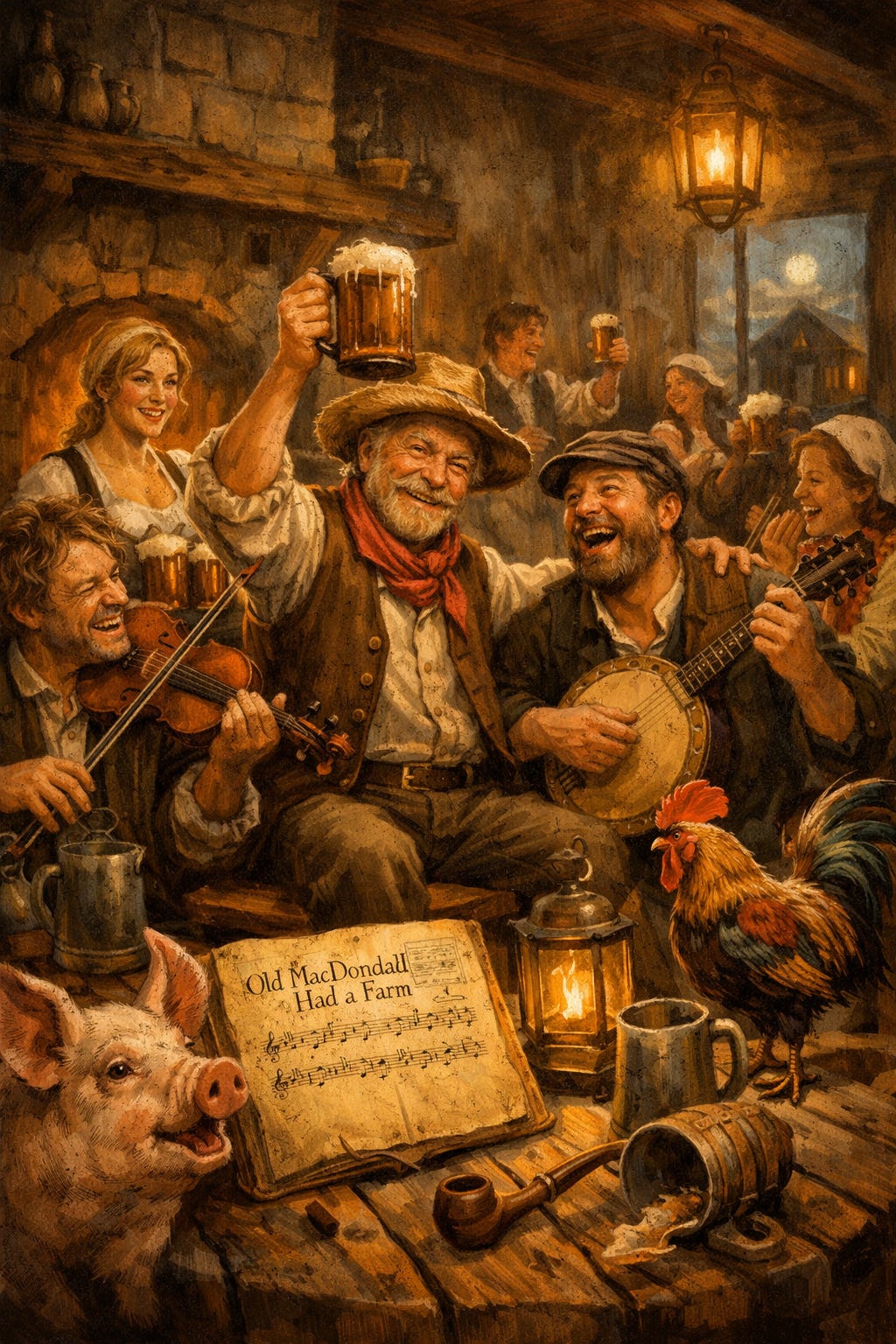
Few songs in Western culture come across as more harmless than “Old MacDonald Had a Farm.” It is routinely offered as evidence of musical innocence: a nursery rhyme full of livestock, nonsense syllables, and cheerful repetition. It appears in daycare centers, church nurseries, pediatric waiting rooms, and early-childhood music curricula with a confidence that borders on moral certainty.
That confidence is slightly misplaced, to say the least.
“Old MacDonald Had a Farm” did not originate as a children’s song. It was not composed to teach toddlers about animals, agriculture, or sound imitation. Its lineage traces back instead to a genre of adult comic folk songs circulating in eighteenth-century Britain and Ireland—songs designed for social gatherings, taverns, and communal amusement, rather than the classroom. In that world, the word “comic” was academic shorthand for “dirty.” Like many such dirty songs, its humor relied on accumulation, euphemism, and participatory escalation.
The modern children’s version of “Old MacDonald” is not a misinterpretation of the song’s history; it is the result of an extraordinary process of cultural migration, functional repurposing, and selective erasure. What makes the song remarkable is not merely that it survived this process, but that it came out the other side even stronger—structurally intact, globally portable, and pedagogically potent.
“Old MacDonald Had a Farm” is best understood not as a melody but as a musical framework: a communal tool refined by American folk practice, particularly in the rural South and Appalachia, and later disseminated worldwide because of its structural efficiency. Its apparent simplicity masks a sophisticated folk-pedagogical design that teaches core musical principles while concealing its origins in adult social culture.
The earliest documented ancestors of “Old MacDonald” appear in Britain and Ireland under titles such as “Old Macdougal Had a Farm” and “Old Macdougal Had a Fiddle.” These were not children’s songs in any meaningful sense. They were comic folk pieces structured around listing, repetition, and cumulative verse building—features that allowed performers to improvise content while remaining within a stable formal shell.
In eighteenth-century folk contexts, such structures served a specific social function. They enabled humor that could be escalated gradually, disguised through metaphor, and denied if necessary. The “farm” functioned less as a literal agricultural setting than as a narrative container—a neutral space into which suggestive imagery, social satire, and bodily humor could be safely inserted. The animals themselves often operated as euphemisms, their sounds standing in for references that were understood by listeners but rarely spelled out.
This strategy of plausible deniability is a hallmark of British and Irish comic folk traditions. It appears in songs about farmers’ daughters who didn’t farm, milkmaids who did far more than milk, and fiddles that were almost never just fiddles. “Old MacDonald” belongs squarely within this tradition. Its participatory nature, combined with its flexible content, made it well-suited to adult communal singing, particularly in informal social settings where alcohol, familiarity, and escalating bravado shaped performance.
There is not one filthy original lyric, but dozens—perhaps hundreds—of them creating a well-documented dirty folk song ecosystem where farms, animals, fiddles, and sounds were euphemisms for moral permissiveness. An additional comic strategy in the song involved variants of social embarrassment, not just sex. Basically, everyone knew the double-meanings and pretended not to notice. You may use your own imagination to consider the old nursery rhyme “Hey diddle diddle, the cat and the fiddle.”
What matters for the song’s later history is not the specific content of these early versions—which varied widely—but the structure that carried them. It’s the structure that would prove to be unusually resilient.
“Old MacDonald” crossed the Atlantic before it was fully sanitized. In the United States, especially in rural and agrarian communities, folk songs were rarely treated as fixed artifacts. They were tools—adapted to context, stripped of nonessential elements, and reshaped to meet communal needs.
American folk culture tends to simplify out of pragmatism, not prudishness. Songs survive if they can be used to pass time, to coordinate labor, to include participants regardless of skill, and to transmit patterns through oral repetition. In this environment, the suggestive content of “Old MacDonald” was gradually replaced, not abruptly censored. Euphemisms slowly gave way to animals, and tavern companions gradually gave way to children, but the participatory engine of the song remained untouched.
The song’s strongest American foothold emerged not in cities but in rural regions—particularly Appalachia and the broader Deep South. These areas favored oral transmission over print culture, communal participation over performance, and improvisation within stable forms. Appalachia, in particular, functioned as a cultural holding tank for older British folk structures that were sanitized or abandoned elsewhere. Ethnomusicologists have long noted that many Appalachian songs preserve formal characteristics that predate Victorian parlor sensibilities, and “Old MacDonald” is no exception.
By the time the song became recognizable in its modern form, it bore the marks of this Southern and Appalachian shaping: modular verses, call-and-response design, and an emphasis on participation over virtuosity. “Old MacDonald” survived because it was useful.
When children’s publishing and recording industries encountered “Old MacDonald” in the late nineteenth and early twentieth centuries, they found a song already optimized for mass adoption. Its melody was serviceable but unremarkable. Its real power lay in its design.
Musically, “Old MacDonald” is much more structural than melodic. It operates on a fixed harmonic and formal loop while allowing infinite variation in content. This makes it unusually portable. Call-and-response structures are nearly universal. Listing forms appear across cultures. Sound imitation transcends language barriers. As a result, the song does not require translation so much as substitution.
This explains its remarkable global spread. Versions of “Old MacDonald” appear across Europe, Asia, Africa, and Latin America, each incorporating local animals, sounds, and sometimes rhythms. Yet the song remains instantly recognizable. Most folk songs do not travel this well. They fragment, localize beyond recognition, or lose their structural integrity. “Old MacDonald” does not. It becomes “local” without ceasing to be itself.
In France, it is “Danse la Ferme de Mathurin.” In Germany, it is “Old MacDonald Hat ‘ne Farm.” The Latin American version is “El Viejo MacDonald,” and the Japanese version is “Old MacDonald no Noujou.” In Italy, it is “Nella Vecchia Fattoria,” and in Sweden it is “Bonden och Krakan.” Every culture preserves the pause, the regrouping moment, and a way for the leader to reset the form.
Perhaps the most striking aspect of “Old MacDonald” is what it teaches without announcing itself as instruction. Within its seemingly simplistic framework, the song introduces listeners—often very young ones—to sophisticated foundational musical concepts: variation over a fixed structure, cumulative form, improvisation within constraints, and ensemble timing.
Kids quickly learn that the form remains constant while the content changes. They learn how to wait for cues, how to re-enter after a refrain, and how individual contributions fit within a collective structure. No talent or specialized skill is required; engagement is the only prerequisite. In this sense, “Old MacDonald” functions as an introductory course in folk music theory, delivered entirely through participation.
This pedagogical efficiency helps explain the song’s endurance. It rewards involvement rather than talent, making it ideally suited for communal use. Long before it became a nursery rhyme, it trained adults to listen, respond, and collaborate. Its later adoption as a children’s song did not alter this function; it merely shifted the audience.
The refrain “E-I-E-I-O” has inspired countless humorous and speculative interpretations, none of them really necessary. It is not an acronym, a code, or a relic of pastoral symbolism. It is a vocable—a sequence of sung sounds without semantic meaning, designed to perform a function rather than convey information.
Vocables are common in folk traditions precisely because they are efficient. They hold rhythm, cue group participation, and fill space without requiring memorization. The job of a vocable is not to say something, but to do something.
Folk music is full of these. “Fa-la-la.” “Hey-nonny-nonny.” “Tra-la-la.” Long before songs were written down, singers needed sounds that could hold a rhythm in place while cueing the group and filling space without requiring anyone to remember words. Nonsense syllables solved all of that at once.
The particular vowels in “E-I-E-I-O” are easy to project, easy to unify across voices, and easy to repeat. They move cleanly from the front of the mouth to the back. Children can sing them. Groups can shout them. Intoxicated adults in taverns can manage them without disagreement. Nobody has to negotiate pronunciation or meaning, and everyone can join immediately.
Do people all over the world sing “E-I-E-I-O?” No, but they all sing something that does the same job. Structurally, the refrain operates as a reset mechanism. It separates verses, gives the leader time to improvise the next variation, and invites the group back into the song. In earlier improvisatory contexts, this pause was essential. Remove it, and the song collapses.
That is why “E-I-E-I-O” survived when so much else changed. Lyrics were cleaned, and the content was standardized, but the refrain remained because the song needs it to be functional. Its lack of meaning is not a deficiency, but is the source of its power.
“Old MacDonald Had a Farm” is many things at once: a sanitized descendant of adult comic folk song, an American communal tool, a global musical framework, and a stealth instructor in music theory. Its transformation into a children’s song did not strip it of function, but more importantly, preserved that function by redirecting it.
The “farm” was never really about animals. It was about people—about participation, accumulation, and shared experience. The song works for children precisely because it was designed for adults who needed something to do with their hands, their voices, and their drunk friends and neighbors at the end of a long day.
Even the cleanest songs can survive, especially if they understood human messiness from the very beginning.
Excellent as always. The “not for children” children’s song reminds me of McClintock’s “Big Rick Candy Mountain,” with its cigarette trees and cops with wooden legs. Do these sorts of songs migrate over to the children’s side largely by virtue of their titles?